How Vessco Water Helps Data Centers Reduce Water Use, Lower Energy Consumption, and Build Community Trust
Every conversation we have with data center developers, engineers, contractors, employees and community leaders seems to come back to the same question:
How do we continue building the digital infrastructure our economy depends on while being responsible stewards of water and energy?
It’s a question we think about every day.
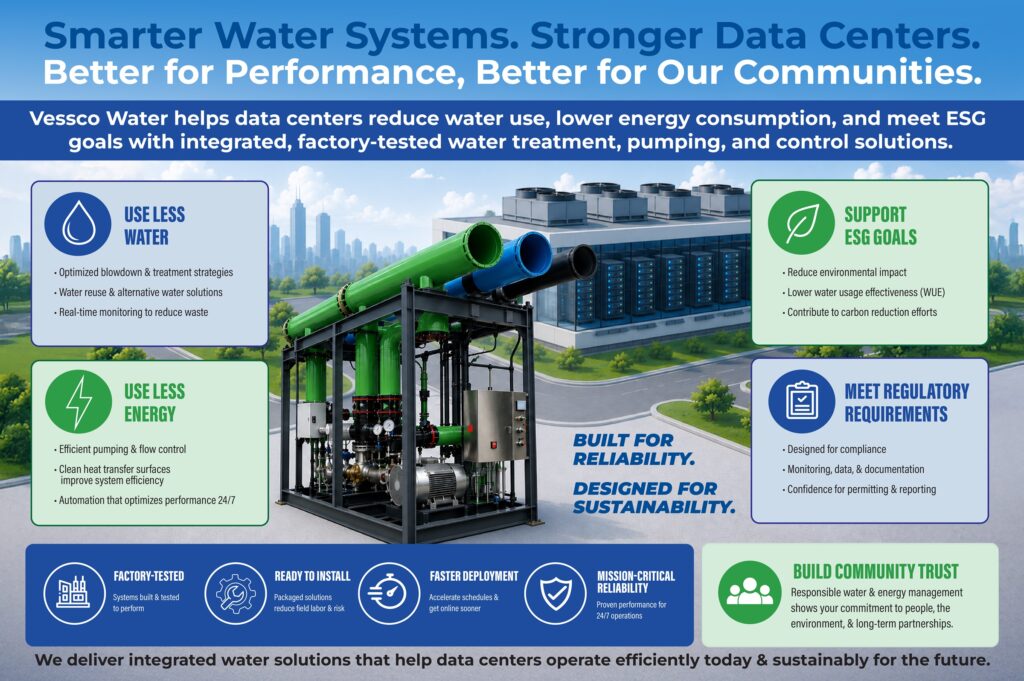
At Vessco Water, we’re actively helping build the next generation of data centers across North America. We see firsthand how quickly the industry is growing and how important these facilities have become to our daily lives. Artificial intelligence, cloud computing, healthcare, education, financial services, manufacturing, and public safety all depend on reliable digital infrastructure.
We also understand that communities want confidence that new data centers will be designed and operated responsibly.
The good news is that sustainability and reliability are not competing priorities.
In fact, many of the same engineering decisions that improve cooling system reliability also reduce water consumption, lower energy use, and support environmental goals.
That’s why we believe the conversation around data center sustainability should focus less on tradeoffs and more on smarter infrastructure.
When cooling water systems are designed correctly from the beginning, facilities can often:
-
- Use less water
-
- Consume less energy
-
- Improve cooling performance
-
- Reduce operational risk
-
- Simplify regulatory compliance
-
- Support ESG reporting goals
-
- Build stronger community trust
The key is making those decisions early in the design process.
Sustainability Isn’t Just an ESG Goal – It’s Good Engineering
One of the biggest misconceptions we encounter is the idea that energy and water sustainability initiatives somehow come at the expense of performance.
Our experience has been exactly the opposite.
The most sustainable data centers we’ve worked with are usually the facilities with the most stable cooling systems, the best water management practices, and the strongest operational discipline.
When we evaluate cooling water systems, many of the problems we see are familiar:
-
- Excessive blowdown
-
- Scaling and fouling
-
- Unstable water chemistry
-
- Inefficient pumping systems
-
- Poor monitoring visibility
-
- Reactive maintenance practices
These aren’t just operational issues.
They’re water efficiency issues.
They’re energy efficiency issues.
And increasingly, they’re ESG issues.
Every gallon of water lost through poor cooling system performance represents both an environmental cost and an operating cost.
Every additional kilowatt consumed because heat exchangers have become fouled affects both sustainability metrics and facility economics.
That’s why we encourage data center developers and engineers to think about water infrastructure as one of the most important ESG opportunities inside the facility.
The Water-Energy Connection Most People Overlook
When people hear the term ESG, they often think about energy consumption first.
Energy is certainly important, but water and energy are closely connected inside every cooling system.
When cooling water systems become inefficient:
-
- Heat transfer performance declines
-
- Pumping requirements increase
-
- Chiller loads rise
-
- Maintenance requirements grow
-
- Operating costs increase
A cooling system that uses more water than necessary often uses more electricity than necessary as well.
Likewise, a system that is optimized for stable operation frequently improves both water and energy performance simultaneously.
This is why we focus on integrated solutions rather than isolated components.
The goal isn’t simply to install a water treatment system or a pump package.
The goal is to create a cooling water infrastructure strategy that supports reliability, sustainability, and long-term operational performance together.
How Vessco Water Helps Data Centers Reduce Water Consumption
One of the most immediate opportunities for improving ESG performance is reducing unnecessary water use.
Our team helps data center owners and engineers evaluate cooling water systems from a total lifecycle perspective.
That includes:
Optimizing Blowdown Strategies
Many facilities either waste water through excessive blowdown or create reliability risks through overly aggressive water reduction strategies.
We help clients find the balance between water efficiency and operational stability.
Improving Water Treatment Performance
Following Water Treatment Best Practices for Data Center Liquid Cooling Systems reduces:
-
- Scaling
-
- Corrosion
-
- Biofouling
-
- Heat transfer losses
Clean systems operate more efficiently and require fewer corrective interventions.
Supporting Water Reuse Initiatives
Many communities are interested in alternative water strategies and reduced dependence on potable water supplies.
We help clients evaluate treatment, monitoring, and infrastructure requirements that may support reuse opportunities (including stormwater reuse) while maintaining reliability.
Increasing Visibility Through Monitoring
You can’t manage what you don’t measure.
Integrated monitoring and controls allow operators to understand:
-
- Water consumption
-
- Conductivity trends
-
- Blowdown performance
-
- Water quality conditions
-
- Overall system efficiency
That visibility helps drive both sustainability improvements and operational reliability.
Better Water Systems Often Mean Lower Energy Consumption
One of the most overlooked benefits of effective water management is improved energy performance.
Clean heat transfer surfaces transfer heat more efficiently.
Stable flow conditions reduce pumping inefficiencies.
Proper controls reduce unnecessary equipment operation.
When cooling systems perform as intended, facilities often consume less energy while maintaining better operational stability.
This is particularly important as AI workloads continue increasing thermal densities across the industry.
Higher cooling loads create less margin for inefficiency.
The facilities that will perform best over the next decade are the ones investing in smarter cooling infrastructure today.
Regulatory Compliance Starts with Better Water System Design
For many data center projects, regulatory compliance begins long before the first piece of equipment arrives on site.
It starts during planning.
Water use, wastewater discharge, treatment strategy, monitoring capability, and system documentation all matter when a project is being reviewed by local utilities, permitting agencies, and community stakeholders.
Our experience is that compliance conversations become much more productive when developers can show that water infrastructure has been thoughtfully designed from the beginning.
That means being able to answer questions like:
* How will the facility manage water consumption?
* How will cooling tower blowdown or wastewater be handled?
* What water monitoring systems will be in place?
* How will water quality be maintained?
* What happens if source water conditions change?
* How will the facility document performance over time?
Vessco Water helps data center teams prepare for those conversations by designing systems that support visibility, control, and documentation.
That includes integrated treatment systems, pumping systems, controls, monitoring, instrumentation, and packaged assemblies that can be planned, tested, and documented before installation.
Good compliance planning is not just about meeting minimum requirements.
It is about reducing uncertainty for developers, engineers, regulators, and communities.
Building Community Trust Through Practical Data Center Infrastructure
Community concerns around data center development are real, and they deserve practical answers.
City leaders and residents want to know that new facilities will use resources responsibly, protect local infrastructure, and contribute positively to the region.
We believe one of the best ways to build trust is to move the conversation from broad promises to specific infrastructure decisions.
Instead of simply saying a facility will be “sustainable,” developers should be able to explain how the project is designed to reduce water use, improve energy efficiency, manage discharge, and monitor performance.
That is where water infrastructure becomes part of the public story.
A stronger community message sounds like this:
“We are designing the cooling water systems to conserve water, reduce waste, monitor performance, and operate reliably under real-world conditions.”
That kind of message is easier to support when the right systems are built into the project from the start.
Vessco helps data center teams put real infrastructure behind their sustainability commitments through engineered water treatment, pumping, controls, automation, monitoring, and prefabricated systems.
For communities, that means more transparency.
For developers, it means a stronger case for responsible growth.
ESG Reporting Requires Measurable Performance
ESG goals are only as strong as the data behind them.
It is not enough to say a facility is designed to use less water or operate more efficiently. Owners and operators need systems that can help measure, monitor, and document performance over time.
That is especially important for data centers, where water and energy use are increasingly part of corporate sustainability reporting, investor expectations, customer requirements, and community discussions.
Vessco Water supports ESG reporting by helping facilities track the performance of critical water systems.
Depending on the project, that may include monitoring:
* Water consumption
* Blowdown rates
* Conductivity
* Flow
* Pressure
* Temperature
* Chemical feed performance
* Treatment system status
* Alarm conditions
* System trends over time
This data helps operators understand whether the system is performing as intended.
It also helps identify opportunities for improvement before small inefficiencies become larger operational problems.
The most useful ESG data is not collected after the fact.
It is built into the infrastructure.
That is why monitoring, automation, and controls should be part of the design conversation early.
Prefabricated Infrastructure Helps Reduce Risk and Accelerate Deployment
Speed matters in data center construction.
But speed without control can create risk.
As project schedules compress, more owners, contractors, and engineers are looking for ways to reduce field labor, minimize installation variability, and improve commissioning predictability.
Prefabricated water infrastructure is one way to do that.
Vessco Water provides packaged, factory-tested, fully integrated systems that can be delivered ready for installation at data center sites.
These systems may include:
* Controls and instrumentation
* Integrated mechanical and controls components
By moving more work into a controlled data center cooling water system fabrication environment, project teams can reduce field coordination challenges and improve consistency.
That can help reduce:
* Installation time
* Field labor requirements
* Startup issues
* Rework
* Commissioning delays
* Site coordination risk
For data center developers, prefabrication supports faster deployment.
For contractors, it simplifies installation.
For operators, it creates more consistent systems from site to site.
For ESG goals, it can reduce waste, improve quality control, and support more efficient project delivery.
Vessco Water’s Data Center Platform
Vessco Water’s data center platform is built around a simple idea:
Data center water systems need to be fast to deploy, reliable to operate, and efficient over the long term.
That requires more than individual components.
It requires integrated systems designed around the realities of mission-critical environments.
Vessco supports data center projects with:
* Packaged data center water treatment systems
* Automation and instrumentation
* Cooling water system support
* Prefabricated piping and assemblies
* Water reuse and treatment strategies
* Startup, commissioning, and lifecycle support
Our team helps owners, engineers, contractors, and developers connect the pieces that matter most: water efficiency, energy performance, operational reliability, compliance, and speed to deployment.
That is especially important as data centers become larger, denser, and more complex.
The facilities being built today need infrastructure that can support tomorrow’s computing loads, ESG expectations, and community standards.
At Vessco Water, we are committed to helping data center teams build that infrastructure responsibly.
Not just because it is good for the environment.
Because it is good engineering.
Final Thought: Responsible Growth Requires Smarter Systems
Data center growth is not slowing down.
The question is how the industry grows.
We believe the path forward is through better infrastructure, clearer performance data, smarter water management, and stronger partnerships between developers, engineers, contractors, utilities, regulators, and communities.
Water systems may not always be the first thing people think about when they think about data centers.
But they have a major impact on how these facilities perform, how much water and energy they use, how reliably they operate, and how confidently communities can support them.
Sustainable data center development starts with practical decisions made early.
And many of those decisions begin with water.
More Information:
Contact Vessco Water today to discuss your data center water cooling system needs.