Engineer’s Guide: Why PP-RCT Has Emerged as the Preferred Piping Material for Liquid-Cooled Data Centers

Share This Article

The rapid growth of AI, hyperscale computing, and high-density server racks is fundamentally changing how engineers design cooling infrastructure for mission-critical data centers.

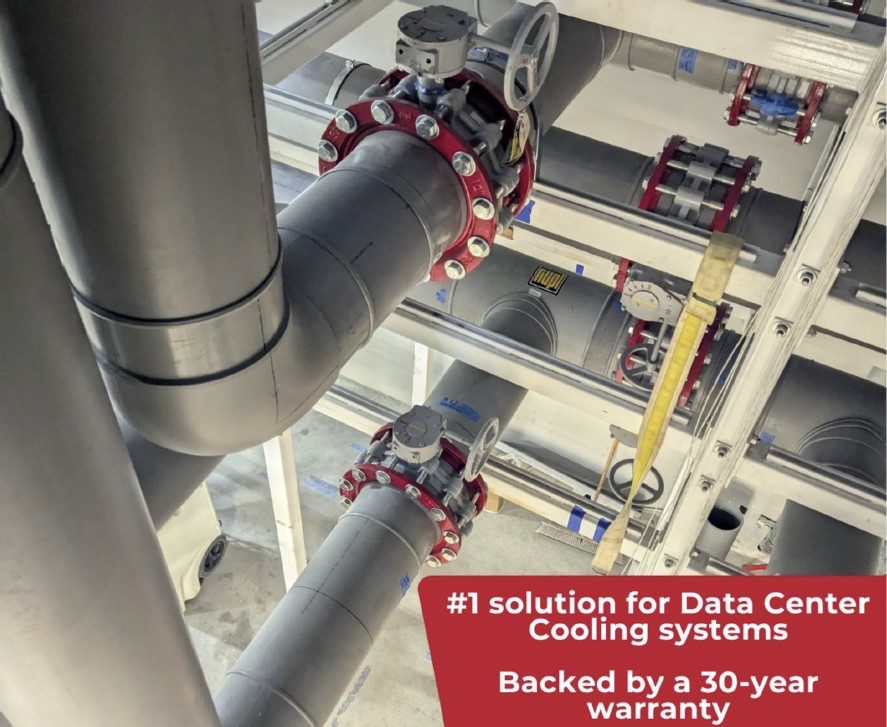
Traditional chilled water systems built with carbon steel, stainless steel, or copper are increasingly being replaced by PP-RCT piping (Polypropylene Random Copolymer with Modified Crystallinity) because it solves many of the long-term reliability and installation challenges found in mission-critical cooling systems.

Today, many engineers designing liquid-cooled data centers specify PP-RCT because it delivers:

    • Corrosion-free performance

    • Leak-resistant heat-fused joints

    • Lower installation costs

    • Faster project schedules

    • Reduced maintenance

    • Improved sustainability

    • Long service life

For mission-critical facilities where downtime is unacceptable, PP-RCT has become one of the most compelling piping materials available.

The Problem with Traditional Metal Piping

Steel and copper have served commercial HVAC systems for decades, but data centers place unique demands on piping systems.

Common issues with metal piping include:

Corrosion

Steel eventually corrodes.

Corrosion products can:

    • Reduce flow

    • Foul heat exchangers

    • Damage valves

    • Contaminate cooling loops

Scaling and Deposits

Even stainless steel systems can accumulate deposits over time.

Deposits reduce:

    • Heat transfer

    • Pumping efficiency

    • Cooling performance

Heavy Weight

Metal piping requires:

    • Additional structural support

    • Larger crews

    • Cranes

    • More labor

Welding Risks

Traditional welding introduces:

    • Fire hazards

    • Hot work permits

    • Fumes

    • Extended installation schedules

These challenges become especially important when constructing or expanding operational data centers
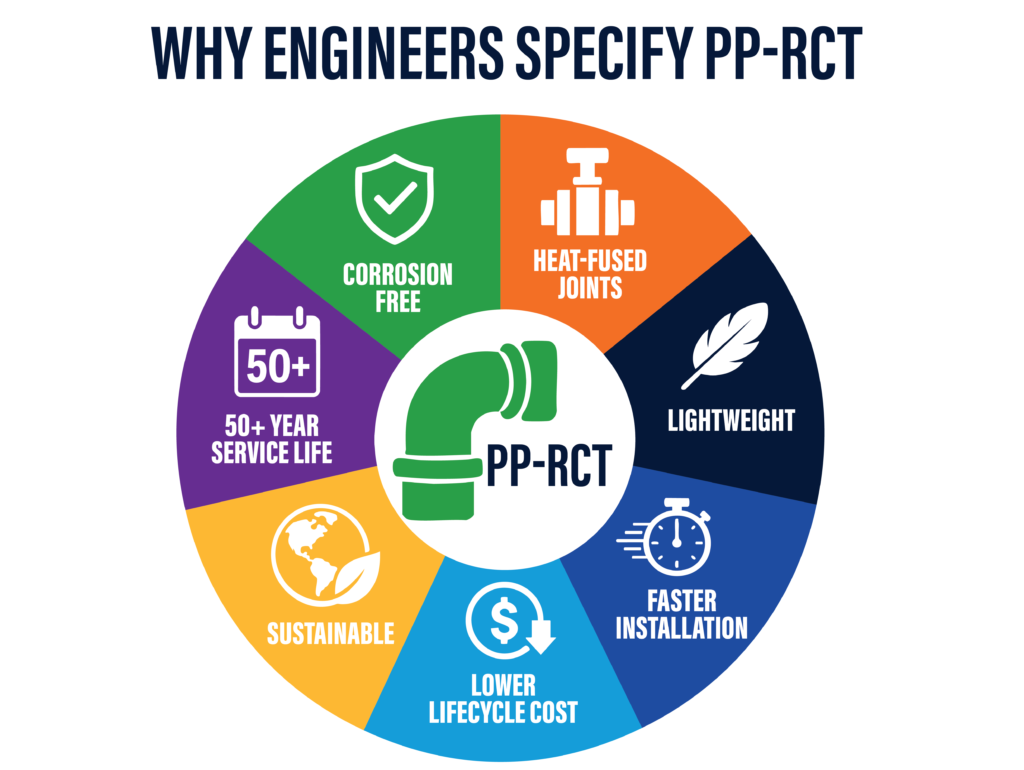
why engineers specify pp-rct for mission critical data centersWhy PP-RCT is Preferred for Mission Critical Applications

1. Corrosion-Free Performance

Unlike steel, PP-RCT:

    • Does not rust

    • Does not scale

    • Resists many chemicals

    • Maintains smooth interior surfaces

This helps maintain consistent flow rates throughout the system’s life while reducing maintenance requirements.

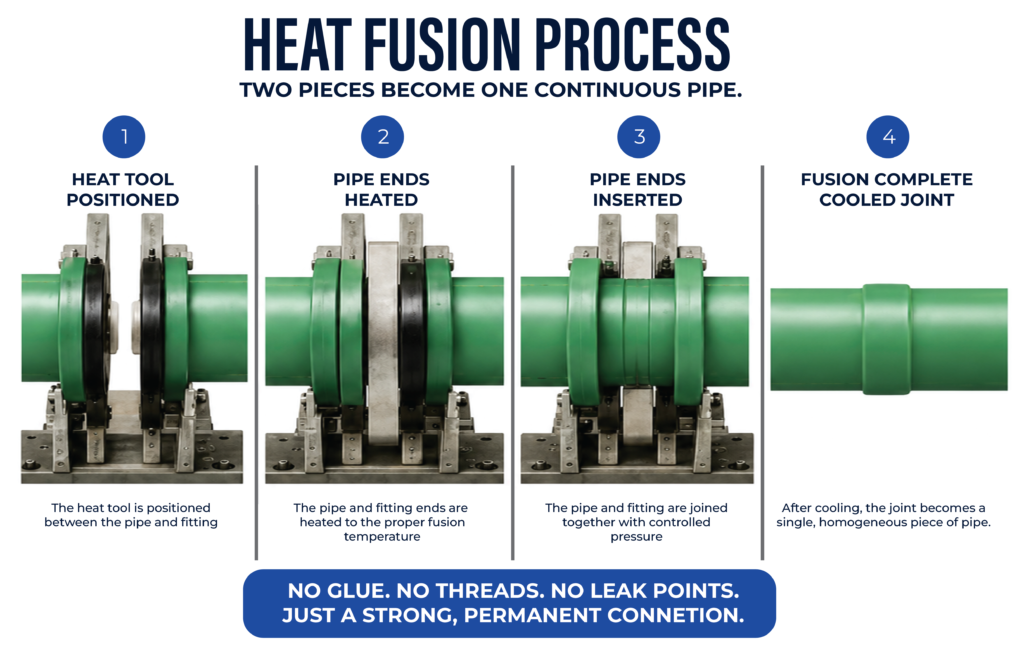
2. Heat-Fused Joints Create One Continuous Pipe

Perhaps the greatest engineering advantage is the joining method.

Instead of:

    • Threaded joints

    • Soldered joints

    • Mechanical couplings

    • Glued joints

PP-RCT uses heat fusion.

Heat fusion permanently melts the pipe and fitting together into one homogeneous material.

The result is:

    • No gasket

    • No adhesive

    • No threaded connection

    • No mechanical weak point

The joint effectively becomes part of the pipe itself, dramatically reducing leak potential.
3. Faster Installation

Construction schedules matter.

PP-RCT is significantly lighter than steel, allowing installers to:

  • Move more pipe with fewer workers
  • Install overhead piping more easily
  • Reduce equipment requirements
  • Accelerate project completion

Manufacturers also support extensive off-site prefabrication, enabling complete assemblies to arrive ready for installation.

4. Lower Total Installed Cost

Although material pricing varies by project, engineers frequently realize savings through:

  • Reduced labor
  • Faster installation
  • Fewer fittings
  • Simplified supports
  • Reduced equipment rentals

The overall installed cost is often lower than comparable metallic systems.

5. Excellent Thermal Performance

PP-RCT piping for data center cooling has naturally lower thermal conductivity than metal.

Benefits include:

  • Reduced heat gain
  • Less condensation
  • Improved system efficiency
  • Reduced insulation requirements in many applications

This is especially valuable for chilled water systems operating below ambient temperatures.

6. Long Service Life

Modern PP-RCT systems are designed for decades of operation.

Manufacturers commonly reference expected service lives exceeding 50 years when systems are properly designed and installed.

7. Sustainability

Many hyperscale operators have aggressive ESG goals.

PP-RCT supports these objectives through:

  • Recyclable materials
  • Reduced embodied carbon compared with many metal systems
  • Lower transportation impacts because of lighter weight
  • Reduced maintenance over the system lifecycle

These characteristics can contribute toward sustainable building objectives such as LEED certificationR

Why PP-RCT Works Especially Well in AI Data Centers

AI computing is increasing:

  • Rack densities
  • Cooling loads
  • Water flow requirements

Modern liquid cooling systems demand piping that can reliably deliver chilled water without introducing corrosion, leaks, or maintenance concerns.

PP-RCT’s combination of durability, low weight, heat-fused joints, and corrosion resistance makes it particularly well suited for these mission-critical environments.

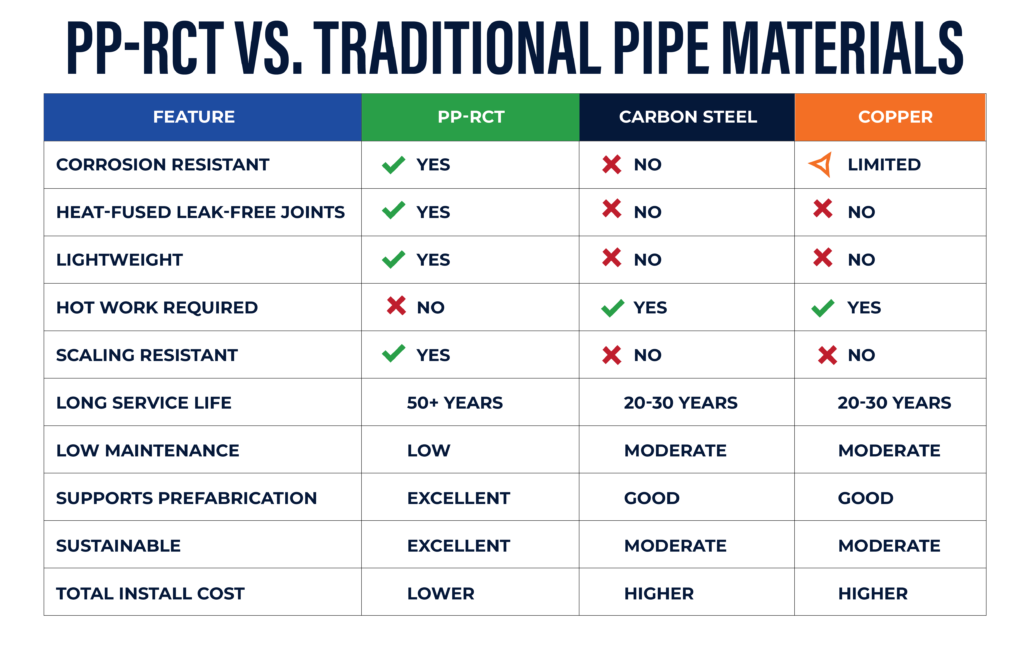
PP-RCT comparison to steel and PVC

Santa Fe Water Systems: PP-RCT Solutions for Data Centers

As a Vessco Water Platform Partner, Santa Fe Water Systems supplies engineered PP-RCT piping systems for mission-critical data center cooling applications.

Santa Fe provides:

  • Engineering support
  • BIM coordination
  • Prefabricated piping assemblies
  • PP-RCT piping systems
  • Cooling water skids
  • Factory testing
  • Startup assistance
  • Field technical support
  • North American project support

Working through the Vessco Water platform also provides customers with access to regional engineering, service, controls, pumping, and water treatment expertise across North America.

More To Explore