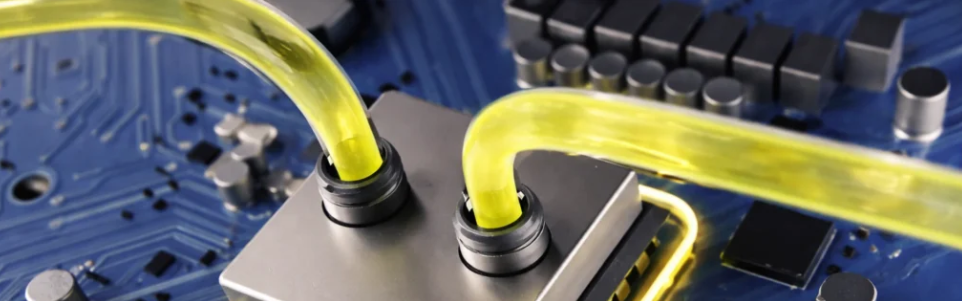
For years, engineers associated glycol primarily with freeze protection in HVAC systems.
Today’s AI-powered data centers have changed that.
As rack densities continue climbing beyond 100 kW, and in many cases toward 200 kW per rack, traditional air cooling alone can no longer remove enough heat from modern CPUs and GPUs. Direct-to-chip (DTC) liquid cooling has quickly become the preferred approach because it removes heat directly from the processors where it is generated.
That shift has elevated an often-overlooked design decision into a mission-critical engineering consideration: Selecting the right heat-transfer fluid.
Why Direct-to-Chip Cooling Uses Liquid Instead of Air
Air simply cannot keep pace with the heat flux generated by today’s AI accelerators.
Instead of attempting to cool an entire server with conditioned air, direct-to-chip cooling circulates coolant through precision-machined cold plates mounted directly on CPUs and GPUs. The liquid absorbs heat at the source before transferring it to a coolant distribution unit (CDU), heat exchanger, or data center facility cooling loop.
This approach offers several advantages:
- Higher cooling capacity
- Lower fan energy consumption
- More consistent processor temperatures
- Support for significantly higher rack densities
- Improved thermal efficiency for AI workloads
As AI infrastructure expands, single-phase direct liquid cooling is expected to remain the dominant liquid-cooling architecture because it is efficient, reliable, and easier to deploy than two-phase systems.
Why Glycol Matters
At first glance, water appears to be the ideal coolant because of its excellent heat-transfer characteristics.
However, real-world data center cooling systems must operate reliably for years, not just perform well on day one. That’s where glycol becomes valuable.
A properly formulated glycol solution helps engineers balance thermal performance with long-term system reliability by providing:
- Freeze protection for outdoor piping and heat rejection equipment
- Corrosion protection for mixed-metal systems
- Stable fluid chemistry
- Material compatibility
- Reduced biological growth
- Longer equipment life
Rather than serving only as antifreeze, today’s inhibited glycol formulations have become engineered heat-transfer fluids designed specifically for mission-critical cooling applications.
Fluid Properties Directly Affect Cooling Performance
The coolant circulating through a direct-to-chip system does much more than move heat.
Its physical properties influence nearly every aspect of system performance, including:
Viscosity
Higher viscosity increases pumping energy and affects flow distribution through microchannels inside cold plates.
Thermal Conductivity
Determines how efficiently heat moves from the processor into the coolant.
Specific Heat
Influences how much thermal energy the fluid can absorb before its temperature rises.
Fluid Stability
Consistent chemistry helps maintain predictable thermal performance over years of operation.
Even small variations in coolant quality can affect flow balance and localized chip temperatures in high-density computing environments.
Corrosion Protection Is Just as Important as Cooling
Modern liquid-cooling systems often contain multiple materials, including:
- Copper
- Stainless steel
- Brass
- Aluminum
- Engineered polymers
- Elastomers
Without proper corrosion inhibitors, galvanic corrosion and chemical degradation can reduce cooling performance while shortening equipment life.
Engineered glycol formulations include inhibitor packages designed to protect these mixed-metal systems while maintaining coolant chemistry over extended operating periods.
Clean Fluid Means Reliable Cooling
Data center cooling loops operate continuously. Over time, contamination can lead to:
- Reduced heat-transfer efficiency
- Restricted flow
- Pump wear
- Fouled cold plates
- Increased maintenance
High-quality inhibited glycol formulations help maintain cleaner cooling loops while reducing biological growth and minimizing the frequency of chemical treatment compared to untreated water systems.
For mission-critical facilities where downtime is measured in millions of dollars, maintaining coolant quality is every bit as important as selecting pumps, heat exchangers, or piping materials.
The Engineering Trade-Off
Like nearly every engineering decision, selecting glycol involves balancing competing priorities.
Increasing glycol concentration improves freeze protection but also changes viscosity, heat-transfer characteristics, and pumping requirements.
That means engineers should evaluate:
- Lowest expected ambient temperature
- Cooling architecture
- Equipment manufacturer requirements
- Required corrosion protection
- Pump performance
- Long-term maintenance strategy
The “right” glycol concentration is not always the highest concentration. It’s the concentration that best matches the operating conditions of the system.
How Vessco Water Helps
Selecting the correct glycol is only one piece of a successful liquid-cooling design. Through R.L. Deppmann, a Vessco Water company, and the broader Vessco Water Platform, engineers have access to expertise in:
- Heat-transfer fluids
- Glycol chemistry
- Pump selection
- Heat exchangers
- Cooling distribution equipment
- Water treatment
- PP-RCT piping systems
- Prefabricated cooling water skids
- Controls and system integration
Whether you’re designing a hyperscale campus or upgrading an enterprise AI facility, Vessco Water helps engineers build cooling systems that are efficient, reliable, and designed for long service life.
Frequently Asked Questions
Is glycol always required in direct-to-chip cooling?
Not always. Some OEMs specify treated water inside the server loop, while others recommend specially formulated glycol solutions depending on system architecture, climate, and equipment requirements. Engineers should always follow equipment manufacturer recommendations.
Why not use pure water?
While water provides excellent heat transfer, it offers little freeze protection and limited corrosion resistance without additional chemical treatment.
Does glycol reduce cooling performance?
Compared with pure water, glycol slightly reduces heat-transfer efficiency and increases viscosity. However, properly engineered concentrations provide an excellent balance between thermal performance and system protection.
What type of glycol is commonly used?
Most data center applications use inhibited propylene glycol formulations because they provide freeze protection, corrosion resistance, and compatibility with common cooling-system materials.
How does coolant quality affect AI servers?
Poor fluid quality can contribute to fouling, corrosion, restricted flow, and reduced heat-transfer efficiency—all of which may increase processor temperatures and reduce long-term reliability.
Can glycol help extend equipment life?
Yes. Properly inhibited glycol protects pumps, piping, valves, heat exchangers, and cold plates from corrosion while helping maintain stable fluid chemistry over many years of operation.